


An insulated box can slow down outside heat, but it can’t hold a temperature by itself. For that, you need a good coolant inside, and that’s what our chill pads are for. Allwin’s PCM cooling pads for cold chain packaging are filled with PCM and help your temperature-sensitive products stay in their required range, whether they’re sitting in a cold room or travelling across the country.
There are 10 sizes to pick from, ranging from compact pads for small courier boxes to larger ones for bigger shippers, and each one comes in six phase-change points. For specific packaging needs, we also make pads in custom sizes and shapes.
PCM ice packs are sealed coolant pads placed inside an insulated box, next to your product, to keep it cool in storage and transit. They’re filled with phase change material (PCM), so they’re also called a pcm cooling pack.
PCM melts at one fixed temperature and soaks up heat while it does, which lets the pad hold the box near a set point, such as +5°C, for hours.
Here’s what to know before buying:
How long they last depends on the payload, insulation, outside weather, and trip length.
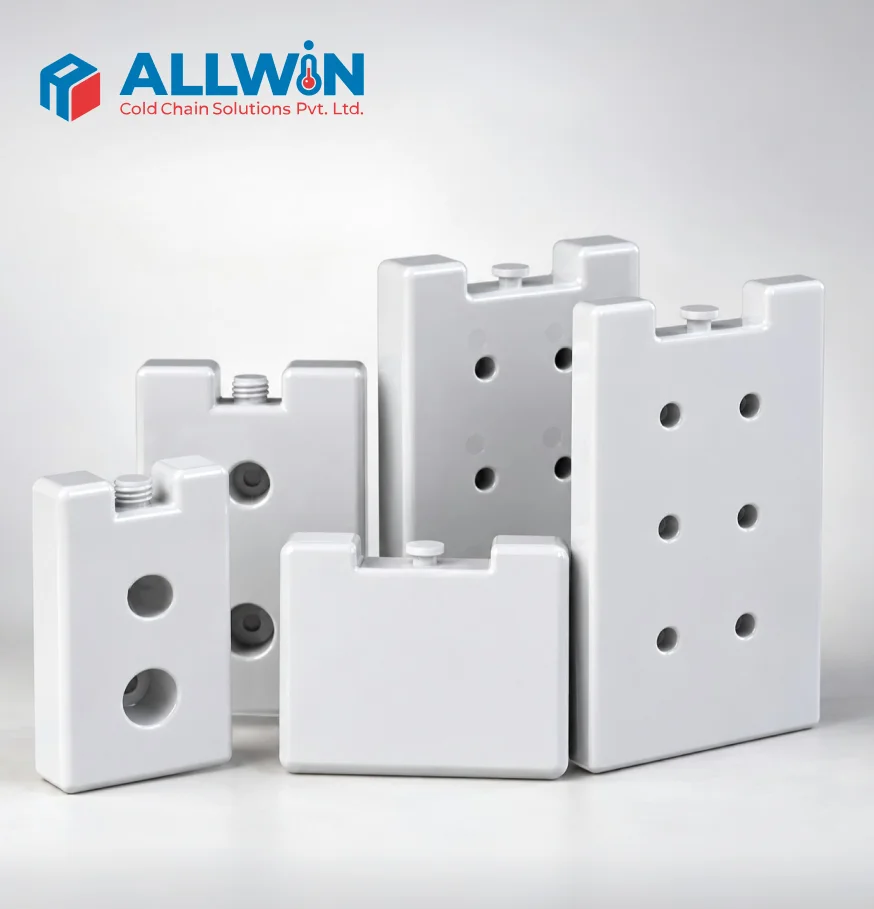
This is what you get when you choose our PCM cold packs.
You’ll find our standard range in the table below.
| Cooling Pads | ||
|---|---|---|
| Model Code | Dimension (mm) LxWxH | Temp Range |
| ACCPC-400-T | 165X95X35 | PC-0,+5,+18,-16,-22,-33 |
| ACCPC-500 | 125x150x35 | PC-0,+5,+18,-16,-22,-33 |
| ACCPC-550 | 220x150x22 | PC-0,+5,+18,-16,-22,-33 |
| ACCPC-600 | 250x150x25 | PC-0,+5,+18,-16,-22,-33 |
| ACCPC-600-T | 190X120X35 | PC-0,+5,+18,-16,-22,-33 |
| ACCPC-750 | 190x150x35 | PC-0,+5,+18,-16,-22,-33 |
| ACCPC-1000 | 250x150x35 | PC-0,+5,+18,-16,-22,-33 |
| ACCPC-1600 | 285x280x25 | PC-0,+5,+18,-16,-22,-33 |
| ACCPC-2000 | 290x230x40 | PC-0,+5,+18,-16,-22,-33 |
| ACCPC-4000 | 330x285x50 | PC-0,+5,+18,-16,-22,-33 |
PCM Cooling packs and the insulated box each do half the job. Used together, they stop the temperature from swinging around between dispatch and delivery.
Cooling and Heat Absorption
The PCM in each pad is conditioned before use until it has fully set. After packing, it starts to melt slowly. As the PCM changes phase, it absorbs heat and helps limit temperature swings around its phase-change point. The shipper’s insulation, the pack-out, and the product load also play a part in the temperature inside the box.
Role of Insulated Boxes and Shippers
The outside heat still tries to get in, but the insulated box lets only a little through at a time, which means the pads aren’t overwhelmed. Put the same pads in a better-insulated box, like one with VIP panels, and they’ll last a good deal longer.
Factors That Affect Temperature Retention
Under normal external conditions, you can expect our chill pads to hold their set temperature for somewhere between 72 and 96 hours. On your route, the actual time will also depend on the insulation, the payload, how many pads you use, and how the box is packed. Share your shipment details with our team, and we’ll help you work out a suitable setup.
Importance of Proper Conditioning and Pack-Out
If a pad isn’t fully conditioned at the right temperature before it goes in, it’ll run out early. Where you place each pad around the product also makes a difference, so it’s worth planning. Our team can help you work out a pack-out for your product and route.
PCM cooling packs are used across various industries to help maintain the required temperature of sensitive products during storage and transportation. From pharmaceuticals and healthcare to food, dairy, and fisheries, they provide reliable cooling support for different cold chain packaging applications.
Pharmaceutical and Healthcare
A good number of vaccines and medicines have to be kept between 2°C and 8°C. For these, PCM cold packs at +5°C are a sensible fit, as long as the pack-out around them has been properly planned and validated. Always go by the product’s approved storage conditions.
Food and Dairy
Chill pads are just as useful for dairy, seafood, ice cream, and other chilled food. If the load is frozen, you’d normally go with -16°C or -22°C pads, whereas chilled items usually travel better with 0°C or +5°C.
Laboratories and Diagnostics
Small courier boxes are the usual choice when labs, hospitals, and testing centres send out samples and reagents. That’s where our compact sizes come in handy, like the 165 x 95 x 35 mm pad, which fits neatly into these smaller shippers.
Logistics and E-commerce
Grocery, meal kit, and pharma deliveries need to stay cool right up to the customer’s door. Courier firms and 3PLs often use chill pads with single-use shippers for these one-way routes.
Here’s why it pays to get the chill pads right.
Choosing the right PCM cold packs depends on your shipment’s required temperature range, transit duration, and product sensitivity. Consider the packaging type and shipping conditions to select chill pads that provide suitable cooling performance throughout transportation.
Required Temperature Range
Look at your product label for the range first. Then go for a pcm ice pack with a phase-change point that falls inside it. A lot of 2°C to 8°C products go well with +5°C pads.
Shipment Duration and Transit Conditions
Work out the total time between packing and delivery, then add some margin for delays. On longer trips, extra pads or a box with better insulation may be needed.
Payload Type and Volume
Cooling a few vials takes far less than cooling a full carton. The size and amount of what you’re shipping will decide how many pads you need and which sizes will fit.
Ambient Temperature During Transportation
In India, a summer route puts a lot more strain on the pads than a winter one. It’s best to plan for the hottest weather your shipment might run into.
Insulated Packaging Compatibility
You want the pads to fit well inside the shipper without squeezing the product. We have sizes for small courier boxes as well as bigger shippers.
Conditioning Requirements and Pack-Out Design
Find out how your pads should be conditioned before use, and decide where each one will go around the product. We can share guidance for your setup if you need it.
Because Allwin designs and supplies complete cold chain packaging, our PCM cooling pads are made to work with our own shippers and boxes. You can go with one of our 10 standard sizes and six phase-change points, or ask us to make pads in a custom size or shape for your product.
This is how our team supports you:
From vaccines to dairy to lab samples, we’ll work with you to find a setup that suits your shipment.

© Copyright 2026 Allwin. All Right Reserved