


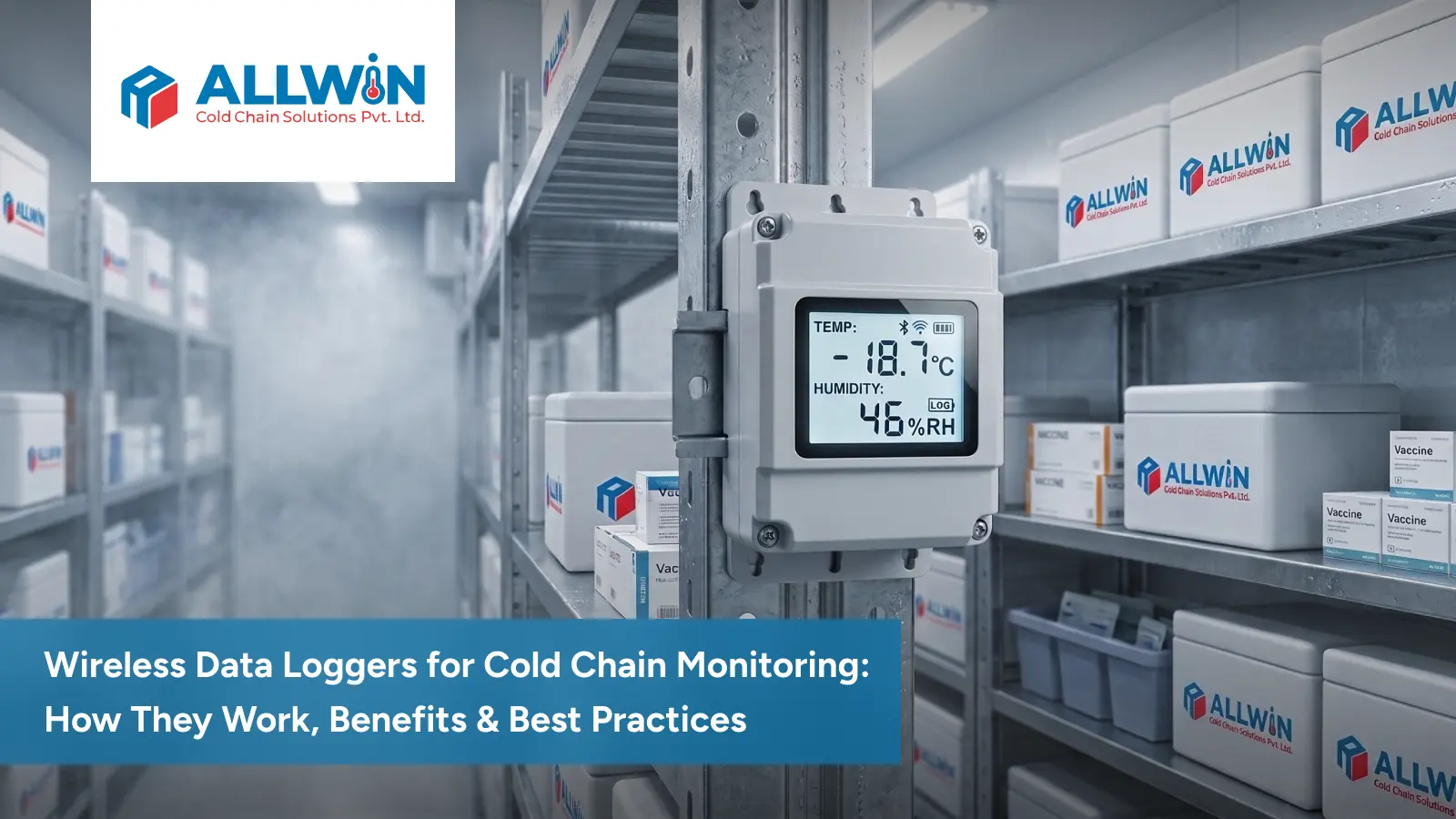
A vaccine fridge fails at 2am on a Sunday. Nobody is in the building. A traditional logger records the whole thing faithfully. But the problem gets found on Monday morning. Someone plugs in the device. Read the file. The stock is already gone.
Now run the same night with a wireless logger. A phone buzzes at 2:05am. Someone drives in. The stock is saved.
That gap is why Wireless Data Loggers took over cold chain monitoring. Old loggers record well. They just tell the story too late. Wireless devices send readings out as they happen. Temperature. Humidity. Time stamps. Alarms when a limit is crossed.
This guide covers how wireless dataloggers work. What types exist. Which connection suits which job. The benefits, the compliance rules, the best practices, and the mistakes that catch teams out.
What Are Wireless Data Loggers? How They Differ from Traditional Loggers
A wireless data logger records conditions and sends them out without a cable. It measures temperature at set intervals. It stamps each reading with a time. Then it transmits to a phone, gateway, or cloud dashboard.
Traditional loggers only do the first half. They record. They store. Someone has to fetch the device and download the file.
The difference shows up fast:
- Traditional loggers give you history. You learn what happened afterwards.
- Wireless dataloggers give you live visibility. You learn what is happening now.
- Traditional loggers need manual collection. Wireless ones do not.
- Only wireless devices raise an alarm in time to save product.
Without real-time monitoring, users can only review temperature history after a shipment arrives. That may be too late to act. That single limitation explains the whole shift.
Learn More: What Is a Data Logger? Types, Benefits & Cold Chain Uses
How Do Wireless Data Loggers Work?
The process is simpler than the technology sounds. A wireless logger does four jobs in sequence. It senses, records, transmits, and alerts. A sensor reads the temperature. The logger saves that reading with a time stamp. A radio pushes it out to software. If the reading breaks a limit you set, an alarm goes off. Everything else is detail.
Here is how a typical wireless datalogging device runs:
- Sensing. A probe measures temperature. Often humidity too.
- Recording. Readings come at a fixed interval. Most devices sample between once a minute and once every quarter hour. Faster settings exist where risk justifies them.
- Local storage. Readings sit in onboard memory as backup.
- Transmission. A radio pushes data to a gateway, phone, or cloud platform.
- Alerting. A breach triggers an SMS, email, or app alert.
One detail gets missed often. Good wireless datalogging systems keep recording when the signal drops. They buffer readings locally, then sync automatically once the connection returns. No gap in the record.
Types of Data Loggers Used in Cold Chain Monitoring
There is no single best logger, only the right one for the job. Three questions settle it. Does your packaging come back? How long is the journey? What is the product sensitive to? Answer those and the choice narrows quickly. Getting it wrong is expensive in both directions. Under-spec and you lose product. Over-spec and you pay for features nobody uses.
Cold chain teams generally use these:
- Single-Use Data Logger. For one-way shipments. Cheap enough to put in every box. Read at delivery, then retired.
- Multi-Use Data Logger. Built for repeat cycles. Suits closed-loop routes where packaging returns.
- Multi-Use Temperature Datalogger. Same reusable format. Focused purely on temperature across many trips.
- Temperature humidity data logger. For goods that react to moisture as well as heat. Biologics. Some electronics. Specialty foods.
- Live wireless loggers. Real-time transmission for storage rooms and high-value loads.
Allwin Cold Chain Solutions supplies three of these directly. Single-Use for one-time shipments. Multi-Use for repeated cycles. And a live temperature and humidity monitoring device for real-time updates.
The rule is simple. One-way lanes point to single-use. Closed loops point to multi-use. High risk points to live monitoring.
Wireless Connectivity Technologies Compared: LoRaWAN vs. Wi-Fi vs. Bluetooth vs. GSM
This is where most buying decisions are actually won or lost. The sensor inside is rarely the weak point. The connection is. A logger that cannot get a signal out of a metal freezer is just an expensive offline device. Each technology trades range against battery life against cost, and none of them wins on all three.
- LoRaWAN. It runs on unlicensed sub-GHz spectrum. It penetrates dense material better than Bluetooth or Wi-Fi. So it reports from inside refrigerators and behind warehouse walls. Devices can run for years on one battery. Best for facility-wide coverage.
- Wi-Fi. Uses infrastructure you already own. But it needs continuous Wi-Fi and drains power faster. Good for fixed sites with solid networks.
- Bluetooth (BLE). Short range, roughly 10 to 100 metres. Very low power. Battery life runs to months, sometimes a year. Best for quick on-site downloads.
- GSM / cellular. Global coverage. It transmits from almost anywhere, which suits long air and sea shipments. The trade-off is SIM fees.
A takeaway worth keeping. Fixed storage usually wants LoRaWAN or Wi-Fi. International freight usually wants GSM. Short local handovers usually want Bluetooth.
See Also: Temperature Data Loggers: A Complete Guide for Food & Pharma
Key Features to Look for in a Wireless Data Logger
Features are what physically sits on the device. This is the spec sheet stage, before you think about routes or use cases. Most deployment problems trace back to something skipped here. A missing calibration certificate. A battery rated for less than your longest lane. Check these once, properly, and you avoid a lot of trouble later.
- Accuracy. Pharma cold chain under WHO and GDP guidance calls for ±0.5°C.
- A calibration certificate. Traceable. Dated.
- Battery life that outlasts your longest route with room to spare.
- Configurable logging intervals. Match the sampling rate to the risk.
- Onboard memory. Nothing is lost if the signal drops.
- Programmable alarms with thresholds you set.
- Data logger devices display. An onboard screen lets staff read the current value with no software at all.
-
Humidity tracking where it matters. If moisture affects the product as much as heat,
a temperature humidity data logger covers both in one device.
Check the humidity range separately, since it is often narrower than the temperature range.
- A rugged, sealed housing for real handling.
High quality data logger devices get all of this right together.
Cheap ones usually fail on battery life or calibration.
Top Benefits of Wireless Data Loggers in Cold Chain Monitoring
The benefits here are practical rather than impressive. Nobody buys a logger because it is exciting. They buy it because product stops getting written off and audits stop being stressful. The value shows up quietly, in stock saved and arguments avoided.
-
Problems get caught in time.
An alert mid-excursion means someone can act while stock is still good.
-
No manual collection.
Staff stop walking around with clipboards and USB sticks.
-
Less spoilage.
Fewer medicines and vaccines written off.
-
Audit-ready records.
Time-stamped data, ready to export.
-
Fewer disputes.
Evidence settles carrier arguments fast.
-
Trend visibility.
Repeat weak points surface across weeks of data.
The shift is subtle but real. Monitoring used to prove what went wrong.
Now it prevents it.
Industry Applications: Where Wireless Data Loggers Are Used
Some industries want temperature control. Others cannot operate without it. The second group is where wireless loggers become standard equipment rather than an upgrade. The pattern is consistent. High-value goods, products that spoil invisibly, or sectors where a regulator will ask for proof.
-
Pharmaceutical.
Vaccines, biologics, and insulin under strict regulatory watch.
-
Medical and biological labs.
Samples, reagents, and diagnostics that fail with no visible sign.
-
Hospitals and clinics.
Fridges and freezers holding medicine and blood products.
-
Food and beverage.
Cold rooms, chilled transport, and processing areas.
-
Logistics and warehousing.
Cold storage sites and refrigerated vehicles.
-
Agriculture.
Produce storage and controlled-environment monitoring.
Allwin works across most of these. Their loggers cover pharma, life sciences,
agriculture, and logistics—tracking temperature and humidity across every stage of the cold chain.
The common thread is risk. High value. Easy to spoil. Or heavily regulated.
Regulatory Compliance & Standards for Data Loggers in Cold Chain
In regulated industries, the temperature record is part of the product. If you cannot prove a batch stayed in range, that batch is questionable regardless of its actual condition. Several frameworks govern how those records must be created, stored, and protected. Knowing them before you buy saves an expensive retrofit later.
-
FDA 21 CFR Part 11.
It requires secure logins, multiple access levels, audit trails of any configuration change,
and data stored so it cannot be altered later.
-
EU GMP Annex 11.
The European equivalent for computerised systems in pharma.
-
GDP guidelines.
EU GDP requires documented environmental conditions across the supply chain.
Deviations must trigger corrective action.
-
Calibration standards.
Sensors producing GMP data are normally calibrated under ISO 17025 accreditation.
Let that calibration lapse and the records lose their standing.
One warning worth taking seriously. Calibration and monitoring gaps now rank among the most cited
failures in FDA pharmaceutical warning letters.
Best Practices for Using Wireless Data Loggers in Cold Chain Monitoring
Good hardware still fails under bad process. A device set up badly gives you data nobody trusts and alerts nobody answers. These habits are not complicated, but skipping them wastes the whole investment. Most of them cost nothing beyond a little discipline.
-
Place sensors at the worst spot.
Not the most convenient one—warmest corner, near the door.
-
Calibrate on schedule.
Keep the certificates filed.
-
Set thresholds around the product.
Not around the equipment.
-
Name who responds to an alert.
And by when. An alarm nobody owns is just noise.
-
Review the data regularly.
Monitoring without review is only storage.
-
Test the alert chain
before you depend on it.
-
Keep a backup.
Onboard memory covers you when the network drops.
-
Treat the logger as part of the packaging.
Allwin builds its loggers to integrate into the packaging itself,
so the data reflects the full system rather than one device sitting in a box.
Common Mistakes to Avoid When Deploying Data Loggers
Almost every monitoring failure is avoidable, and the same handful come up again and again. None are technical failures. They are planning failures. Reading through them once before deployment is far cheaper than learning them the hard way.
-
Too few sensors.
One device cannot represent a whole cold room.
-
Skipping calibration.
An uncalibrated logger produces records with no weight.
-
Alarm fatigue.
Thresholds set too tight, and staff start ignoring alerts.
-
Assuming coverage.
Signal inside a metal freezer is not the same as signal in the corridor.
-
Ignoring battery life.
A logger that dies mid-route leaves a hole in the record.
-
No written procedure.
Without an SOP, response depends on who is on shift.
-
Buying the device separately from the packaging.
The two work as one system.
How to Choose the Right Wireless Data Logger for Your Cold Chain Needs
Features tell you what a device can do. Choosing well means matching that device to your specific situation, which is a different question entirely. The same logger can be perfect on one lane and useless on another. Work through the questions below in order, and the right option usually becomes obvious.
-
Fixed site or moving shipment?
Storage points to LoRaWAN or Wi-Fi. Transit points to GSM or Bluetooth.
-
One-way or closed loop?
That settles single-use versus multi-use.
-
What does the product react to?
Temperature only, or temperature and humidity.
-
What is the worst realistic duration?
Size battery life against that, not the schedule.
-
What does compliance demand?
Regulated goods need calibration certificates and audit trails.
-
Who acts on an alert?
No responder means real-time adds little.
-
Who are you buying from?
A wireless dataloggers manufacturer sells the device.
A cold chain partner matches it to your packaging and routes.
The second usually costs less over time.
The best data logger systems get chosen lane by lane, not from a catalogue.
Why Choose Allwin Cold Chain Solutions for Data Loggers
Allwin treats monitoring as part of the packaging system. Not a gadget dropped in the box. The device, the insulation, and the coolant all serve the same route. That thinking comes from a parent company that has built PUF-insulated ice boxes and shippers for years.
What Allwin brings:
-
Three logger types
covering the main cases. A Single-Use Data Logger for one-way shipments. A Multi-Use Data Logger for repeat cycles. A live temperature and humidity device for real-time visibility.
-
The parameters that matter for cold chain.
Both temperature and humidity, tracked together.
- Loggers built into the packaging, so data reflects how the whole system performed.
- Validated temperature control across the -40°C to +40°C range that Allwin's packaging is built around.
- Support across sectors: pharmaceutical, life sciences, labs, logistics, and ecommerce.
- A full packaging range beside the devices. From single-use packing to reusable shippers, chill pads, and reusable cold chain boxes.
Based in Gandhinagar, Gujarat, Allwin serves cold chain operations across India. For businesses comparing reliable wireless data logger manufacturers and suppliers, that combination counts. A data logger supplier who also builds the packaging can advise around your routes. Not just sell you a device.
Cold chain monitoring has moved from recording to responding. Traditional loggers tell you what went wrong. Temperature Data Loggers with wireless connectivity tell you while it is still going wrong. That is when someone can still fix it.
Getting value from them is not complicated. Match the connection to the environment. Match the logger type to the route. Calibrate on schedule and keep the certificates. Decide who answers an alarm before you need one. Do that, and temperature control stops being a hope. It becomes something you can prove on demand.